

Nevada
FY 2024
On May 20, 1785, the Continental Congress provided land to support schools as each new state joined the union. “There shall be reserved the lot No.16, of every township, for the maintenance of public schools within the said township.” Over 134 million acres were subsequently granted in trust as a condition of statehood. Today over 45 million acres continue to be held in trust by 20 states for the support of public schools. Revenue is placed in permanent school funds, now over $115 billion, and over $5 billion was distributed to western schools in FY 2024. However, few educators or members of the public know about school trust lands. Advocates for School Trust Lands is sharing this grand history of America’s founding vision for schools, hoping that over time Americans will know of school trust lands and their support for public schools.
At statehood ON October 31, 1864, Nevada was granted 2 sections per township--almost 4 million acres of land--by Congress to support Nevada public schools. The school trust lands are part of a “sacred compact” or enabling act between the state and Congress. The enabling act requires the state to act with undivided loyalty as it manages the school lands in trust to support public schools. Recognizing the arid nature of the state, shortly after statehood, Nevada requested that Congress grant only two million acres, but at locations the state selected instead of Sections 16 and 36 that might have no water. About one-fourth of the private land in Nevada today was once school trust lands. Of the original 4 million acres, Nevada has only 2,914 acres remaining. All other arid states admitted to the Union after Nevada, specifically Utah, Arizona, and New Mexico, all received 4 sections. In the 2010 session of the Nevada Assembly, a bill passed requesting that the Nevada Congressional delegation seek an additional 6 million acres to support schools to correct the unequal footing for Nevada receiving only 2 sections when less arid states received 4 sections. There is a doctrine known as the Equal Footing Doctrine that requires each state to be admitted to the union on equal footing.
There are only 2,914 acres remaining from the original lands granted. School trust lands occur throughout the State and are located in Carson City, Clark, Lyon, Nye and Washoe Counties:
• Vicee Canyon, Carson City, 313.79 acres These parcels are west of Western Nevada College.
• Clark County, 164.13 acres These four parcels are east of Las Vegas in the Moapa Valley.
• Elko County, 41.18 acres This remote parcel is northeast of Wells.
• Lyon County, 80.74 acres This parcel is near Wabuska, north of Yerington.
• Nye County, 462.73 acres These remote parcels are scattered across the northern county and also near Pahrump. Flannigan Area,
• Washoe County, 515.22 acres These remote parcels are in the vicinity of Flannigan, northwest of Pyramid Lake.
• Vya Area, Washoe County, 1,345.51 acres These remote parcels are east of Vya in northern Washoe County.
How does this revenue get to schools and benefit students? The revenue from the school trust lands is deposited in the Permanent School Fund, which is invested by the Nevada State Treasurer. All Justice Court Fines and all District Court Fines are also deposited annually in the Permanent School Fund. There is little annual revenue from the remining acreage of less than 3,000 acres. However, in 2009, over $90,000 was deposited from the state finally paying for school trust lands it had been using without compensation.
Beginning in 2012, the Nevada State Treasurer’s office began investing a portion of the Permanent School Fund in 32 Nevada projects using four investment professionals. Some of the funds were invested in the Silver State Opportunity Fund (SSOF) and other funds in mostly metal extraction companies. “As of June 30, 2024, 18 active Nevada-based companies have received investments from SSOF; however, a total of 32 Nevada companies have received investments since the Fund’s inception in 2012. SSOF includes investments throughout 16 Nevada counties. This is a total of $815 million invested in Nevada and its partners, which stretches far beyond the $75 million capital invested in the PSF. SSOF investments have supported 2,470 Nevada employees with an average annual wage of $105,622: 79% higher than the national average wage in 2023.” [1]
The Permanent School Fund is invested by the State Treasurer and has a market value of $539,960,000. Of this total $253 million is in fixed income investments; $266 million in public equity; and $21 million in private equity. The net annual return for FY2024 was 6.5%. In FY 2024 investment income of $16.1 million was distributed to schools in Nevada through the Nevada Distributive School Account.
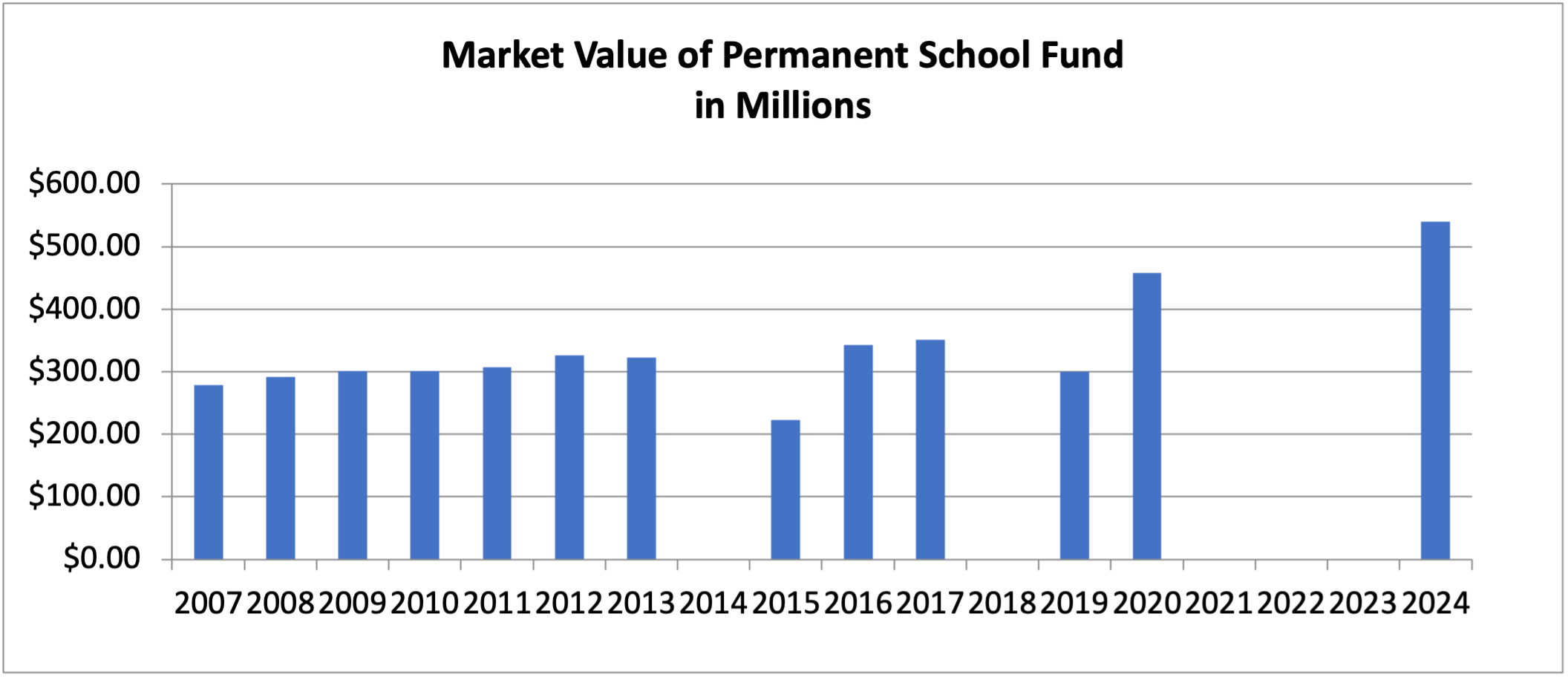
Investment income from the Permanent School Fund is placed into a State Distributive School Fund which is then directly distributed to the public and charter schools, though the public has little knowledge of these funds as they are included with other state funding for schools. Utah allows parents, teachers and the principal in each school to develop academic programs to improve student performance with their funding which raises public support for schools.
[1] December 1, 2024 report by State Treasurer Zach Conine to Legislative Counsel Bureau Director Diane Thornton
