

Washington
June 30, 2024
On May 20, 1785, the Continental Congress provided land to support schools as each new state joined the union. “There shall be reserved the lot No.16, of every township, for the maintenance of public schools within the said township.” Over 134 million acres were subsequently granted in trust as a condition of statehood. Today over 45 million acres continue to be held in trust by states for the support of public schools. Revenue is placed in permanent school funds, now over $40 billion, and billions were annually distributed to western schools. However, few educators or members of the public know about school trust lands. Advocates for School Trust Lands is sharing this grand history of America’s founding vision for schools, hoping that over time Americans will know of school trust lands and their support for public schools.
On November 11, 1889, Washington became a state, and Congress granted two sections of 640 acres each for the support of public schools in each township (six square mile area). Schools received 2,432,554 acres and now hold 1,795,564 acres. [1] These school trust lands are managed by the Department of Natural Resources (website: dnr.wa.gov). Hilary Franz is the Commissioner of Public Lands and is a statewide elected official. Their office is located in the Natural Resources Building at 1111 Washington Street SE, Olympia, WA 98504. Justin Schmal is over the K-12 Common School Lands and is available by phone at (360) 902-1697. The office retains a management percentage of the revenue earned from trust lands to cover their expenses.
“The Trust Land Performance Assessment has shown that over the past 25 years, total net revenue from state trust lands has declined in real dollars.” The Trust Land Initiative is addressing this decline and attempting to reverse its negative impact on school funding. The initiative will be built around three main strategies:
1. Legislative changes designed to increase the amount and the reliability of the revenue generated by the state trust lands portfolio;
2. Changes to Board of Natural Resources policies that improve trust asset management performance;
3. Updates to DNR operational business practices that increase the Department's efficiency and effectiveness in managing state trust assets.
The Initiative recognizes that the state has fiduciary duties to “generate revenue and other benefits for each trust by meeting DNR's trust management responsibilities. Those responsibilities include making state trust lands productive, preserving the corpus of the trust, exercising reasonable care and skill in managing the trust, acting prudently with respect to trust assets, acting with undivided loyalty to trust beneficiaries, and acting impartially with respect to current and future trust beneficiaries.” [2]
During FY2021, the school trust lands in Washington generated $53 million in gross revenue. The largest revenue sources were timber sales, agricultural leases and commercial real estate leases.
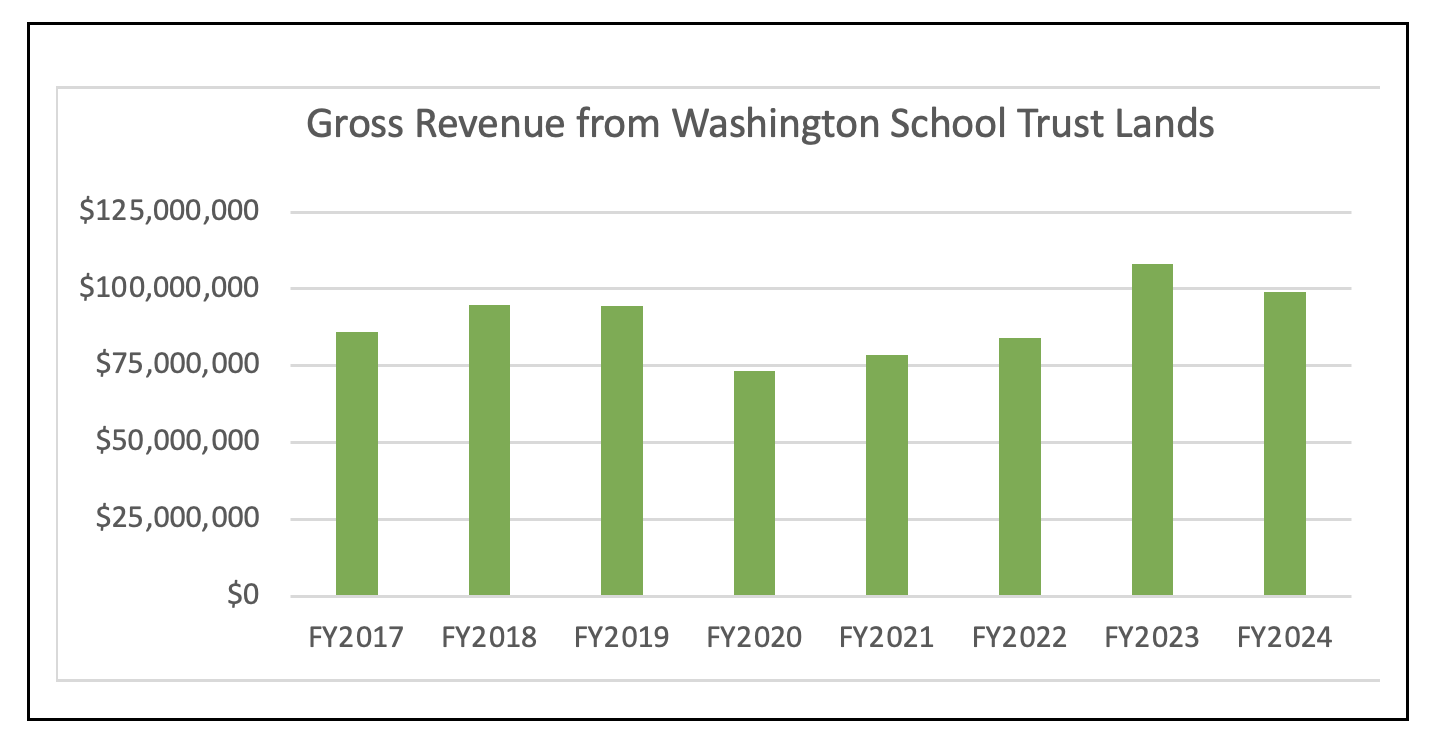
All net revenue generated from the land is deposited in the Common School Construction Account or the Common School Permanent Fund. All lease revenue, material sales of timber, gravel and similar products all contribute to the Common School Construction Account. This Account plus interest derived from the Permanent Common School Fund are used in the Common School Construction Fund exclusively for the purpose of financing the construction of facilities for the common public schools.
Revenue from all permanent transactions like land sales, sales of right-of-Way, and royalty from mineral production are invested annually in the Common School Fund. The permanent fund is invested along with the other permanent funds for the American Indian Scholarship Endowment, the Agricultural School, the Normal School (teacher colleges), the Scientific School and the State University.
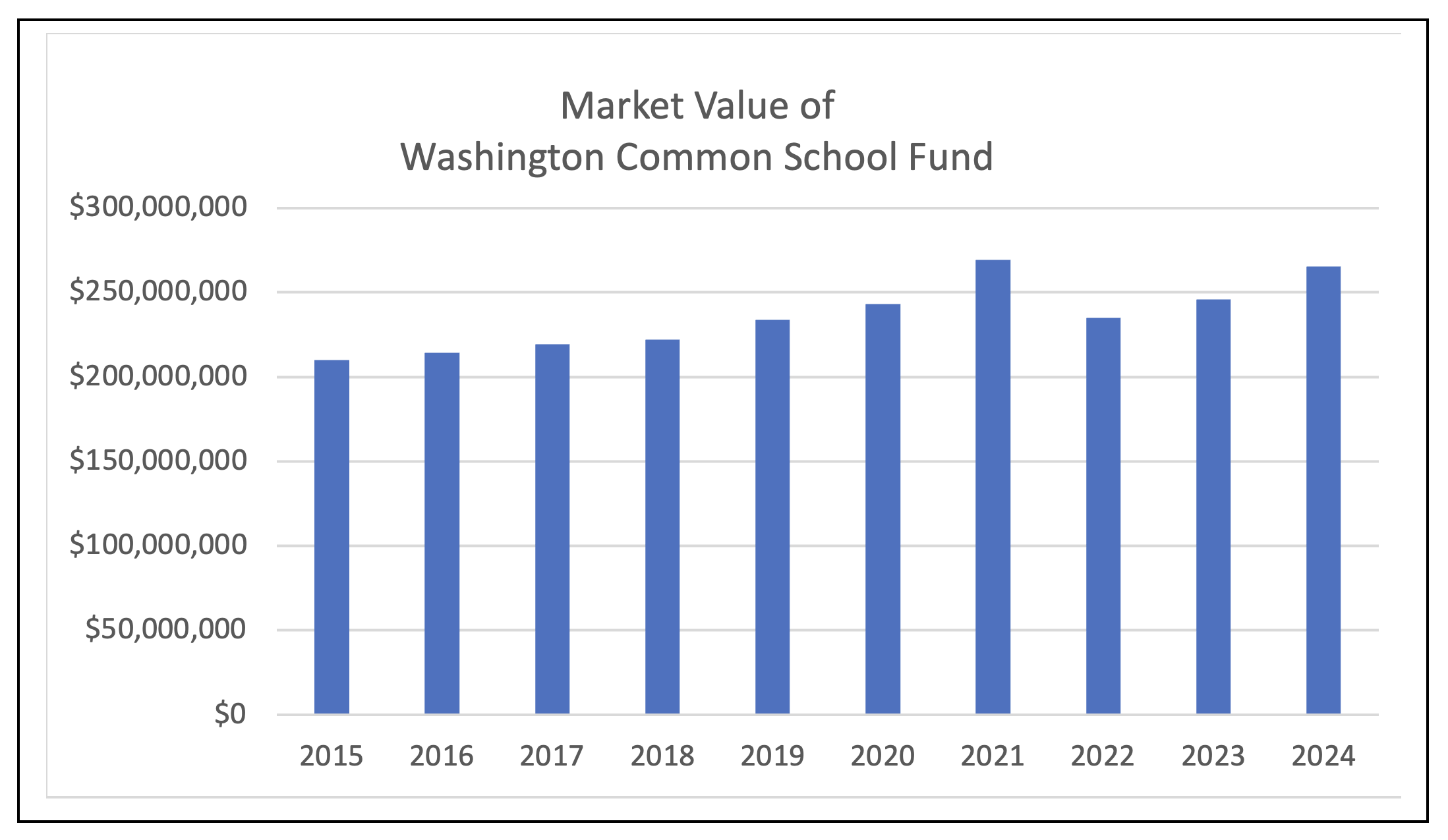
“Net investment position of the Permanent Funds decreased by $163.5 million during FY 2022.” In addition, the net investment position decrease “was due to a 266.6% increase in realized and unrealized losses from the previous fiscal year due to significant declines in market returns.” [3] The asset allocation for FY 2022 as 60.45% in bonds, 39.53% in equities, and 0.02% in Cash and cash equivalents.
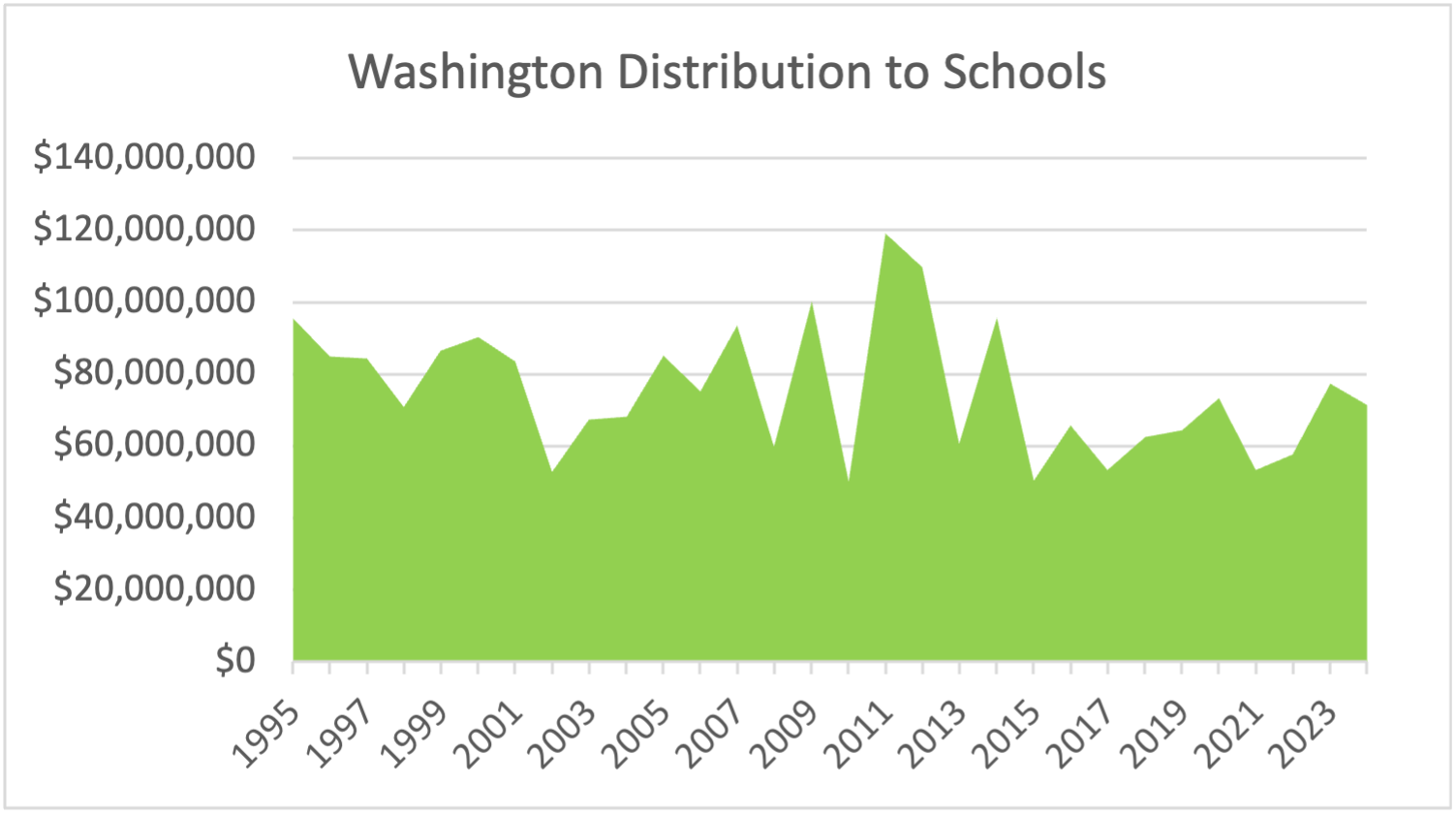
Annually, revenue is distributed to the Common School Construction Account from revenue derived primarily from school investment income but also from the school lands. Rather than benefitting all 2,278 Washington schools annually, Washington’s current distribution benefits a very limited number of selected schools.
The Distribution funds are allotted by the Superintendent of Public Instruction who allots appropriations and determines each district’s state funding assistance or match using formulas established in statute.
[1] This is 2019 data, the most recent available.
[2] Quotes in paragraph taken from dnr.wa.gov website.
[3] Washington State Investment Board FY 2022 Annual Report, p. 90.
