

Montana
(as of June 30, 2024)
On May 20, 1785, the Continental Congress provided land to support schools as each new state joined the union. “There shall be reserved the lot No.16, of every township, for the maintenance of public schools within the said township.” Over 134 million acres were subsequently granted in trust as a condition of statehood. Today over 45 million acres continue to be held in trust by 20 states for the support of public schools. Revenue is placed in permanent school funds, now over $115 billion, and over $5 billion was distributed to western schools in FY 2024. However, few educators or members of the public know about school trust lands. Advocates for School Trust Lands is sharing this grand history of America’s founding vision for schools, hoping that over time Americans will know of school trust lands and their support for public schools.
On November 8, 1889, Montana joined the union, and Congress granted two sections per township for the support of public schools. Schools and other institutions received 6.2 million acres and now hold 5.2 million surface acres and 6.2 million mineral acres. These school trust lands are managed by the Montana Land Board who are the top five statewide elected officials: Governor, Attorney General, Secretary of State, Superintendent of Public Instruction, and Commissioner of Securities and Insurance. Shawn Thomas, Forestry and Trust Lands Administrator, is a classified State of Montana employee and manages the school lands within the Department of Natural Resources. The legislature approves the Division’s budget, but the expenses for managing Trust lands are paid from land revenue. The school lands are working lands, managed sustainably, to support Montana’s public educational institutions.
In Making Hay for Education: Montana’s School Trust Lands , Tom Schultz wrote:
“Trust Lands provide much more than revenue. They provide wildlife habitat, hunting and recreation; they provide jobs, coal, forage, cultural resources, wheat, timber, barley, oil and gas—even dinosaurs. For the generations of farmers and ranchers who have leased them, Trust Lands provide for their families and also provide a way of life.” [1]
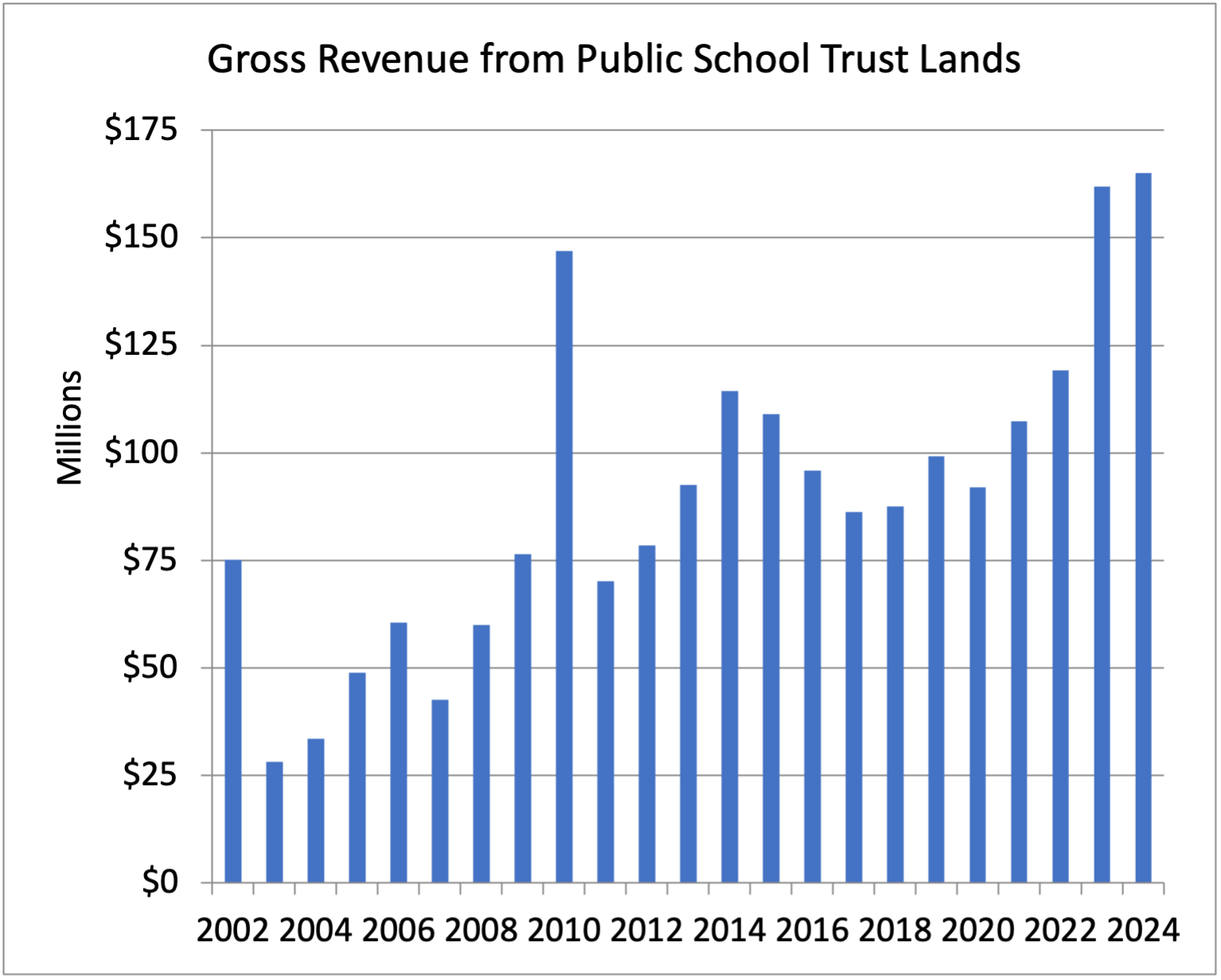
During Fiscal Year 2024, the school trust lands generated $165 million in gross revenue. The largest revenue source was minerals at $42 million with real estate close behind at $39 million. Since Wyoming’s Elk Basin field was extended into Montana in 1915, oil and gas have held the top position for revenue. Ranching and agriculture have traditionally held second place for the most revenue. But not this fiscal year! Real estate was the second highest revenue source with agriculture, grazing, and timber revenue coming in third with $35 million. This year the Board of Land Commissioners granted a conservation easement to the Flathead Land Trust on approximately 400 acres of school trust land commonly known as the Owen Sowerwine Natural Area. The land is adjacent to Kalispell and contains two braided water bodies. This easement provides revenue for schools forever, while protecting the sensitive bird and wildlife area.
Revenue from non-renewable sources like oil, gas and minerals are saved and invested in the Public School Trust Fund. In addition, five percent of both the land revenue and the investment interest are reinvested in the Public School Trust. The School Facility and Technology Account contains certain other revenues from the sale of timber on school land. Montana School Trust lands and funds generated an historic distribution of almost $60 million. Almost all of Montana’s trust distribution is “the first brick in the toilet” to fund schools statewide. The legislature then adds to that amount. This means that if educators work to get more money coming from school lands or funds, they are just freeing up the legislature to appropriate the additional money anywhere else in the state. Thus, the solution is clear. Montana needs to study its current distribution policies now in statute, and consider ways in which they can get real, new money into their schools from the trust granted at statehood.

Market Value of Montana School Trust Fund
The Public School Trust Fund is managed by the Montana Board of Investments. The market value of the Public School Trust Fund is $718 million as of June 30, 2024. The fund is significantly down over the prior year. The fund is invested to both generate revenue for current schools and to provide growth of the fund for future schools.
The Public School Trust Fund is one of thirty-six other trust funds in Montana that are collectively invested. The Montana Board of Investments Annual Report 2024 reported that the collective investment returns of these “Other Trust Funds” was only 4.61% for the current year and 3.16% for the prior 10-year investment return. The report on page 1 does indicates that “The numbers within this annual report are unaudited and may be subject to change in the audit process.”
The revenue to education from the trust established at statehood has varied as a percentage of the overall state funding. In FY2010, one-quarter of all state funding to public K-12 education came from the school trust. Every year it is a dependable funding source for the Department of Education, though not for public schools.
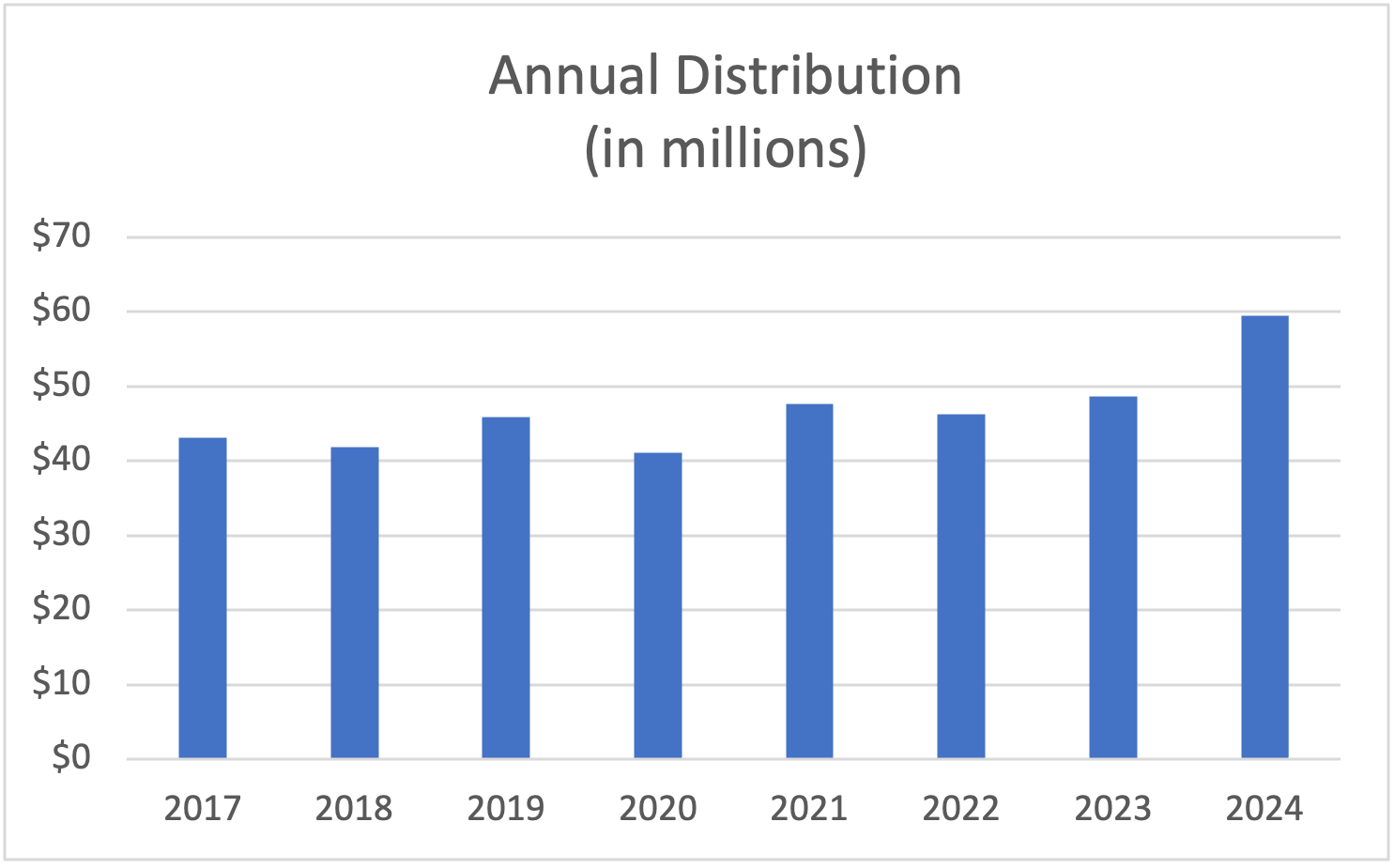
In FY2024 Montana state trust land revenue generated an historic distribution of more than $92 million if the $2 million to School Facility and Technology Fund and $31 million one-time payment from the Avista settlement are included with the distribution from the Investment Board.
[1] See 20-9-516, Montana Code Annotated.
