

Idaho
“The land where miracles grow”
On May 20, 1785, the Continental Congress provided land to support schools as each new state joined the union. “There shall be reserved the lot No.16, of every township, for the maintenance of public schools within the said township.” Over 134 million acres were subsequently granted in trust as a condition of statehood. Today over 45 million acres continue to be held in trust by states for the support of public schools. Revenue is placed in permanent school funds, now over $115 billion, and over $5 billion was distributed to western schools in FY 2024. However, few educators or members of the public know about school trust lands. Advocates for School Trust Lands is sharing this grand history of America’s founding vision for schools, hoping that over time Americans will know of school trust lands and their support for public schools.
On July 3, 1890, Idaho became a state and received sections 16 and 36 in each township of six square miles for public schools. Schools were granted over 3 million acres and today hold 2.1 million surface acres and almost 3 million mineral acres. Additional lands were granted by Congress to the University of Idaho, Idaho State University, Lewis Clark State College, the state mental hospital, corrections, schools for the deaf and blind, and veteran services. The school trust lands are part of a “sacred compact” between Idaho and Congress. This trust requires the state to act with undivided loyalty as it manages the lands to support public schools. The school lands are managed in perpetuity to secure the maximum long-term financial return for the schools. The Idaho Department of Lands is located at 300 North 6th Street, in Boise, ID 83702. These school lands are managed by Dustin Miller, under the direction of the 5-membher Idaho State Board of Land Commissioners, comprised of the top five statewide elected officials-the Governor, the State Superintendent of Public Instruction, the Secretary of State, the Attorney General, and the State Controller.
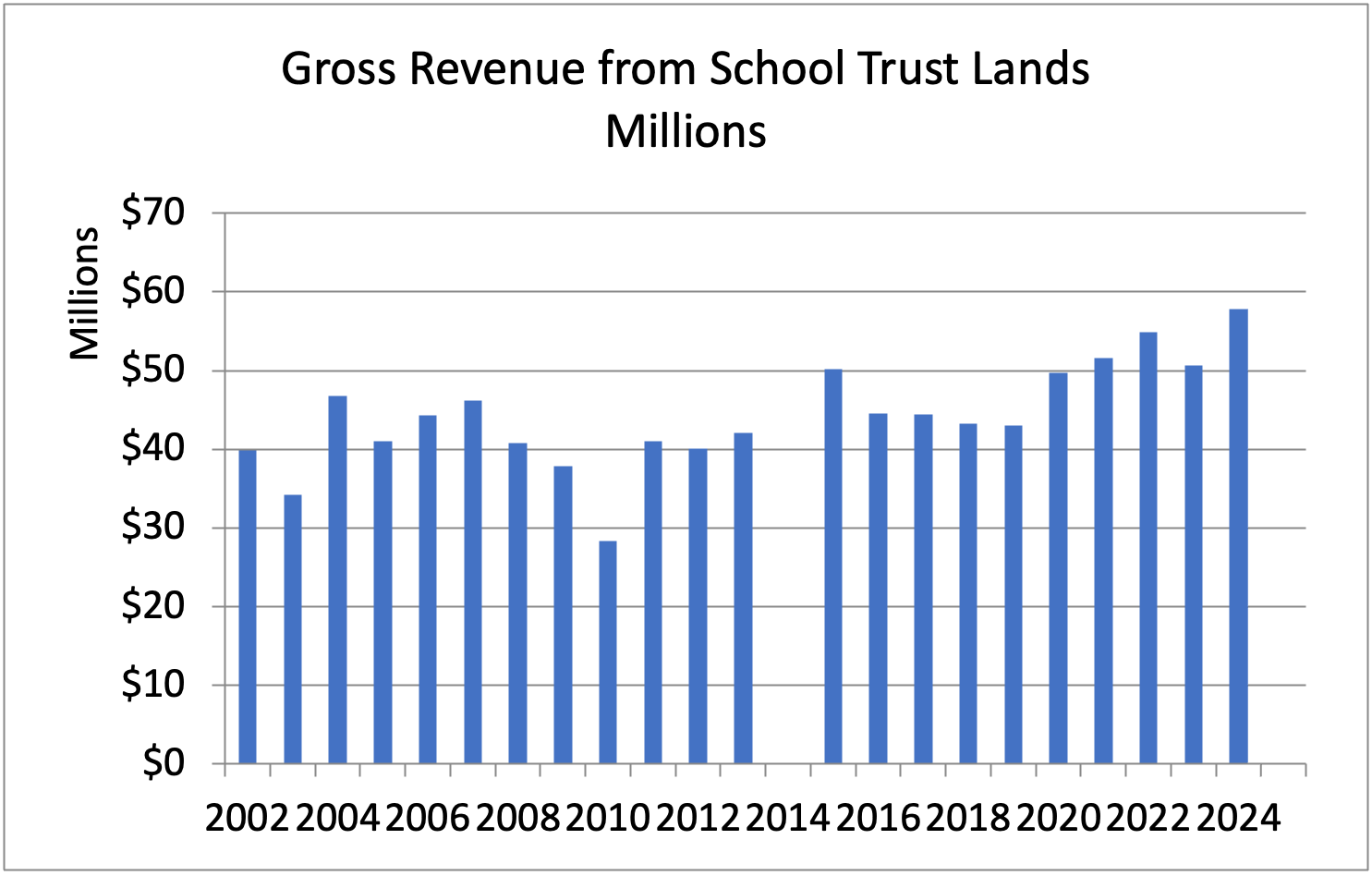
Timber is by far the major revenue source at 86% of total revenue, but rangelands add several more millions annually. Residential and commercial real estate also contribute millions. Other activities such as hunting, recreation, oil and gas leasing and bonuses, and mineral leases and bonuses also contribute.
At statehood, Idaho was required to establish the Public School Permanent Endowment Fund, “Proceeds of the sale of school land . . . shall be deposited in the public school permanent endowment fund and expended only for the support of public schools. . .” [1] All revenue from mineral sources is deposited in the Public School Endowment Fund. Land sale revenue is either deposited in the permanent endowment fund or may be deposited in the land bank fund “to acquire land for beneficiaries.” If bank deposits are not deployed within five years, they are moved to and invested in the permanent fund. School land has generated over a half-billion dollars in the last decade.
All net revenue from renewable resources like timber, grazing, and real estate leases, and all net investment income are deposited in the Earning Reserve Account. All net revenue from mineral resources is saved and invested in the Public School Endowment Fund. The annual distribution to schools is then set by the State Land Board. If actual income has fallen short of the approved distribution, the additional cash comes out of the Earnings Reserve Account, so schools do not run short. If more is earned, then the Earnings Reserve Account grows for a future year or is reinvested in the permanent Public School Endowment Fund. In 1969, the Idaho legislature created the Endowment Fund Investment Board (EFIB). The Land Board comprised of the top five statewide elected officials, sets the policies for the Investment Board. The nine-member investment board is comprised of six individuals “knowledgeable and experienced in financial matters and the placement or management of investment assets,” one state senator, one state representative, and one public school administrator. [2]
Idaho has done an outstanding job investing the Public School Permanent Endowment Fund. In a comparison of returns on twelve sovereign wealth funds developed by RVK, Idaho was fourth from the highest when looking at the last five years and the last ten years. [3] This performance is amazing when one considers that the comparison included Texas at $57 million and New Mexico at $32 billion, and large funds have an advantage at meeting entrance requirements on many investment opportunities.
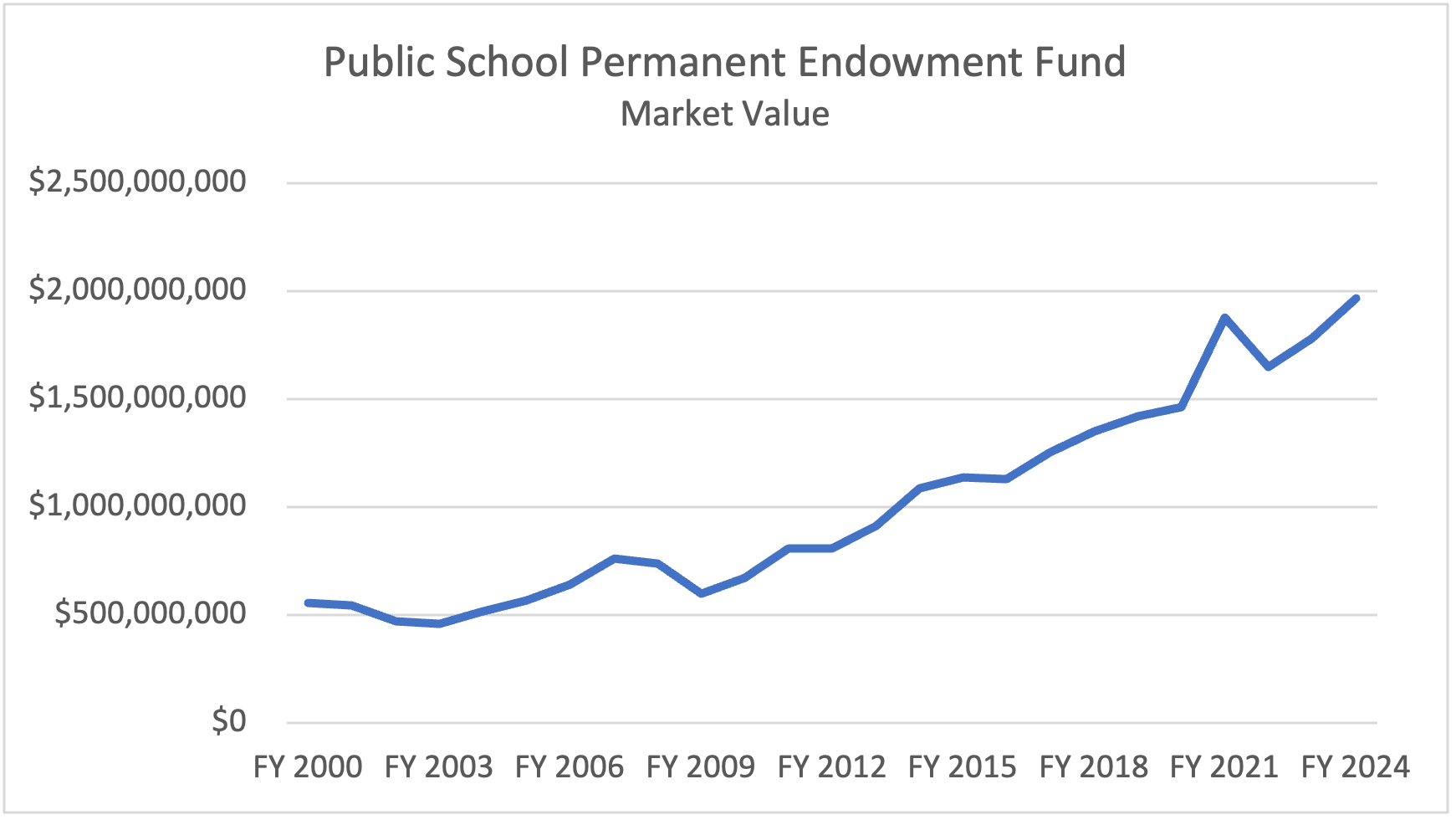
The Public School Permanent Endowment Fund (EFIB) is now almost $2 Billion, including the earnings reserves. Funds are prudently and professionally invested. The 5-year total weighted rate of return is 8.1%, the highest of any of the state permanent funds.
[1] Idaho Enabling Act Section 5(a)(2)(A)(ii).
[2] Idaho code 57-718.
[3] RVK is a large, independent investment consulting company that advises numerous permanent state school funds.
